

Clarity is not about making every message longer. It is about giving the other person the information they need.
Think about a request you have received that left you wondering what was meant. Perhaps it referred to “the thing”, mentioned a deadline without a date or assumed you knew the reason. You may have understood the words and still been unsure how to act.
A useful message reduces that uncertainty. Before adding more detail, ask what the reader needs to understand the situation and take the next step. Their context may be different from yours. A small piece of information that feels obvious to you can be the piece they are missing.
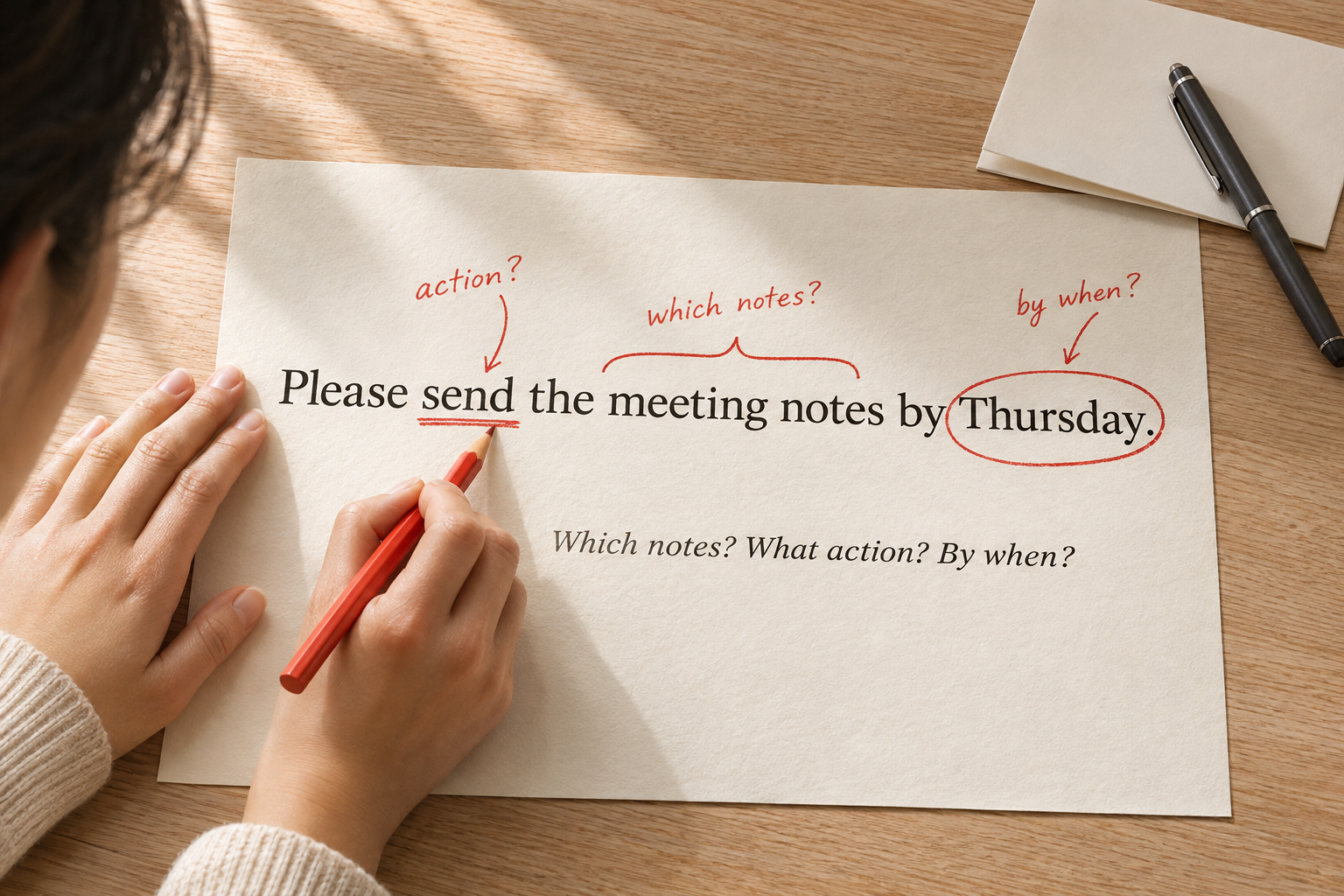 Illustrative practice scene
What does the reader
need to know?
This fictional handoff is not finished when the writer understands it. The other person needs enough information to take the next step.
Give your request
something to stand on.
For an everyday request, three questions are a practical starting point. You do not need to turn every conversation into a formal template. Use them to notice where a message might create avoidable guesswork.
Why this?
Say what the request is for. Context helps the reader judge what is relevant and ask better questions.
What next?
Name the action and the expected result. “Prepare three discussion points” is more specific than “sort it”.
By when?
Give a useful time or an agreed deadline. If the date could be misunderstood, make it explicit.
Start with the reader’s position
Check which background details the reader already has. A colleague in the same project may need a short reminder; someone joining the task for the first time may need the relevant document or a brief explanation. More words are not automatically more helpful. Choose the details that support the action.
Same request.
A clearer next step.
This fictional workplace example shows what changes when useful details are added. Choose a detail and inspect the result.
“Can you get that thing ready?”
What thing? What does ready mean? When is it needed?Please prepare three discussion points for our planning meeting.
Useful detail supports a real action.A concrete action is easier to respond to than “sort the thing”. The reader can picture the expected result.
Notice what the improved version does
The message gives a reason, the task and a visible result. Adding a time can make the next step clearer still. In a real situation, the deadline should be appropriate and agreed where needed. A clear request is not permission to set unreasonable expectations or to ignore the other person’s workload.
The example is deliberately ordinary. You can apply the same thinking to arranging a meeting, asking for information or sharing a handoff. The point is to make the reader’s next action easier to identify.

A clear message
invites a useful reply.
A checking question tests your understanding before you act. This fictional handoff leaves room for the other person to explain a constraint.
“Do you mean the three discussion points for Thursday’s meeting?”
THE WRITER MAKES ROOM“Yes. Is 2pm a realistic time, or do we need to agree another?”
Practise checking what you heard ↗Turn the idea
into your own words.
Choose a low-stakes request you want to make clearer. Use fictional details if you are practising with work-related information. Write one sentence for each question, then read the three together.
Build a useful request.
A practice space for your own thinking. Your notes stay in this browser while the page is open; the website does not submit them.
Could someone outside my own context identify the purpose, the action and the timing? Is any term unclear? Have I left room for them to ask a question or explain a constraint?
Clear can still
sound like you.
A practical framework should support a conversation, not make it mechanical. Keep the tone appropriate to the relationship and the situation. A helpful greeting, an explanation of a change or an acknowledgement of someone’s time may matter as much as the request itself.
Clarity also works in both directions. If you receive a vague request, try a useful checking question: “Do you mean the three discussion points for Thursday’s meeting?” You are checking understanding rather than criticising the speaker.
Does every message need all three details?
No. If the purpose and timing are already shared, a brief action may be enough. The questions help you check for missing information; they are not a rule to repeat known details unnecessarily.
What should I practise next?
Try improving one real message, then notice the response. Did the reader understand the next step? Which question did they still need to ask? Use that evidence to adjust the next message.